Astra vs Conventional Technology
A closer look at the operating principles, footprint and costs of VUV technology.
| Feature | Thermal Oxidation | VUV Technology |
|---|---|---|
| Working Principle | High-temperature thermal oxidation (~760°C+) | Microwave & Ultraviolet (VUV) at room temperature |
| Pretreatment Needs | Required for particles & oil | Required for particles & oil |
| System Configuration | Single large unit often preferred for cost-effectiveness | Highly flexible; single unit or multiple modules possible |
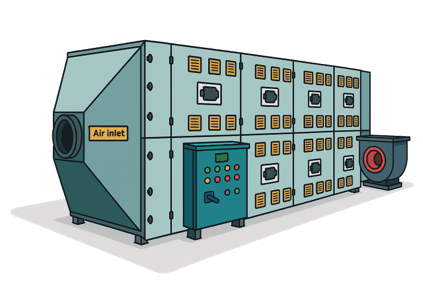
| Footprint | Large (due to ceramic heat recovery beds) | More compact; modular design |
| Energy Consumption | High fuel demand to maintain temperature; electricity for fans | Primarily electricity (no fuel); lower OPEX |
| OPEX Drivers | Natural gas, periodic ceramic media replacement | Electricity, periodic lamp replacement |
| By-product Risks | NOx, potential SO₂ from sulfur content | Minimal; primary by-products are CO₂ and H₂O |

The  Advantage
- Significantly Lower Operating Costs (OPEX)
- Compact and Modular Design
- Ambient Temperature Operation
- Precision Destruction of styrene gas